Introduction
Every day, businesses generate valuable information—from sales transactions and customer interactions to financial reports and operational metrics. Yet many organizations still struggle to transform that information into practical business decisions.
In Quebec City, small and medium-sized businesses (SMEs) are investing in digital tools at an increasing rate. However, many continue to face the same challenge: they have plenty of data but very little visibility into what it actually means.
Business Intelligence is no longer a solution reserved for large corporations. Today, organizations of all sizes can use data analytics to improve efficiency, reduce costs, and make better strategic decisions.
Why Data Is Becoming More Difficult to Manage
As businesses grow, they often adopt multiple software solutions to support different departments.
A typical company may use:
- An accounting platform for financial management
- A CRM for customer relationships
- Excel spreadsheets for reporting
- ERP software for operations and inventory
- Marketing platforms to manage campaigns
While each tool performs its specific function well, they rarely communicate seamlessly with one another.
The result is fragmented information and slower decision-making.
Challenge 1 – Information Is Scattered Across Multiple Systems
One of the most common issues businesses face is disconnected data.
Sales teams, finance departments, operations, and marketing often work with separate systems, making it difficult to obtain a complete picture of business performance.
Without integrated reporting, managers spend valuable time collecting information instead of analyzing it.
Business Impact
- Delayed reporting
- Duplicate work
- Inconsistent data
- Reduced productivity
Challenge 2 – Manual Reporting Consumes Valuable Resources
Many organizations still prepare weekly or monthly reports manually using spreadsheets.
Although spreadsheets remain useful for many tasks, relying entirely on manual reporting increases the likelihood of:
- Human error
- Version control issues
- Time-consuming processes
- Limited scalability
Instead of focusing on business strategy, employees spend hours gathering and formatting information.
Challenge 3 – Lack of Real-Time Visibility
Business leaders need quick answers to important questions such as:
- Which products generate the highest profit?
- Which customers contribute the most revenue?
- Where are operational bottlenecks?
- Which services are growing fastest?
- Which marketing campaigns produce the highest return?
Without centralized dashboards, finding these answers often requires several reports from different departments.
Challenge 4 – Difficulty Identifying the Right KPIs
Many organizations measure dozens of metrics but struggle to identify the indicators that truly drive business performance.
Effective Key Performance Indicators (KPIs) should:
- Align with business objectives
- Be measurable
- Support decision-making
- Be monitored consistently
Choosing the right KPIs allows organizations to focus on what matters most instead of tracking unnecessary information.
Challenge 5 – Making Decisions Without Reliable Data
When accurate information is unavailable, decisions are frequently based on assumptions or intuition.
While experience remains valuable, combining it with reliable data leads to more confident and informed decisions.
Organizations that embrace data-driven decision-making are generally better equipped to identify opportunities, manage risks, and adapt to changing market conditions.
How Business Intelligence Solves These Challenges
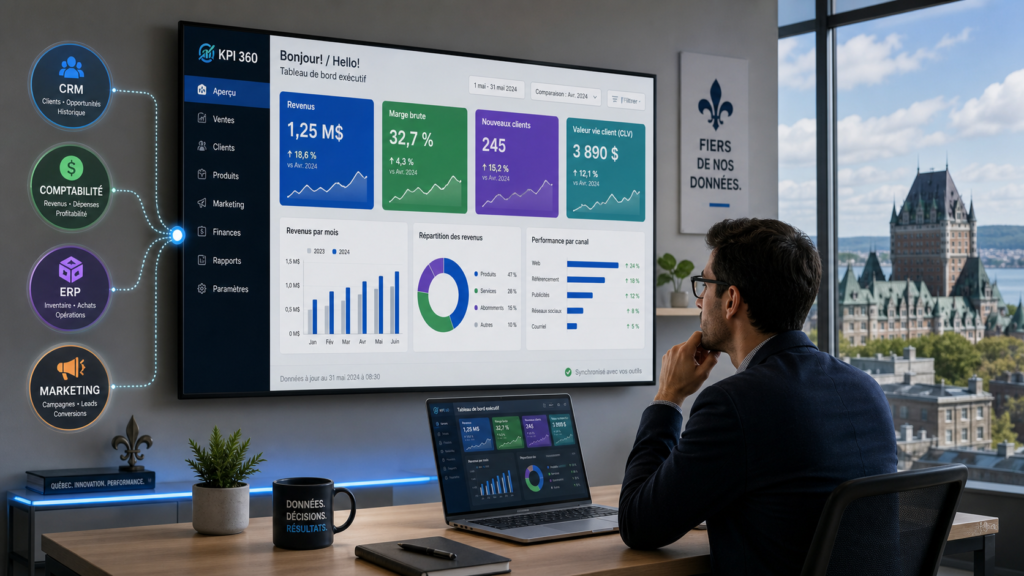
Business Intelligence brings together information from multiple systems into a single source of truth.
Modern BI solutions enable organizations to:
- Centralize business data
- Monitor KPIs in real time
- Automate reporting processes
- Identify trends earlier
- Improve operational efficiency
- Support strategic planning with reliable information
Rather than replacing existing systems, Business Intelligence connects them to create a complete view of business performance.
Why This Matters for Businesses in Quebec City
Quebec City is home to organizations operating in manufacturing, engineering, professional services, logistics, healthcare, retail, and technology.
As competition increases and digital transformation accelerates, businesses that understand their data gain a significant competitive advantage.
Organizations that invest in Business Intelligence can often respond faster to market changes, improve customer experiences, and make more informed strategic decisions.
Key Takeaways
✔ Collecting data is only the first step.
✔ Fragmented information slows decision-making.
✔ Manual reporting reduces productivity.
✔ KPI dashboards improve business visibility.
✔ Business Intelligence helps transform data into strategic insight